A question keeps coming up in conversations about AI agents. Is product discovery still needed at all? The answers I see are usually two. Run the full discovery, or build right away.
I think small features need a third path: a repeatable way for AI agents to check the evidence a team already has, with explicit conditions for sending an idea back to full discovery, and a person deciding at the end.
I call it Fast Track Product Discovery, or the fast track for short. The idea came to me after reading a post on LinkedIn, and I'm already testing it for my own needs on the apps I build.
It is still at the thinking stage and needs a lot of tweaking, so please read this as a proposal for discussion.
Discovery already scales with risk
Classic product discovery walks through stages of understanding a problem, from talking to users and reading the data to prototyping and testing before anything goes into delivery. Marty Cagan names four risks that this work addresses: value, usability, feasibility, and business viability.
Continuous discovery, the approach described by Teresa Torres, changes the rhythm. The team building the product is in touch with customers every week and runs small research activities in pursuit of a desired outcome.
In both approaches, as I understand them, we try to learn enough to make a sound decision about what to build.
An experienced product manager could fairly say that good teams already match the depth of discovery to the risk. I agree.
What the fast track adds is narrower. It makes the light version of that work repeatable, hands the checking of existing evidence to agents, and writes down when an idea has to leave the short path.
Why research it when you can build it?
More and more of the product managers I know use coding agents and can put together a working prototype on their own. That makes it tempting to build the feature right away, ship it, and see what happens.
A second version of the same temptation is to describe the requirements so precisely that they can be implemented immediately.
I do not think that is enough. If we skip discovery entirely, we are simply guessing faster. Cagan writes that building is no longer the hard part and that the critical skill is figuring out what to build.
A survey commissioned by Atlassian points the same way. It was run in August 2026 among 1,000 product professionals at manager level or above, in companies of 500 to 10,000 employees in the US, Germany, and France.
In it, 80% of respondents said that AI is helping them ship faster but customers are not seeing value any sooner. And 86% agreed that as AI makes shipping easier, deciding what to build matters more. These are opinions from people in larger companies, not a measurement of what customers got.
So we still have to ask whether something is worth building. What looks different is the math for small things. For small, reversible changes, the effort spent on discovery should be proportionate to the uncertainty and the cost of being wrong.
What the fast track is
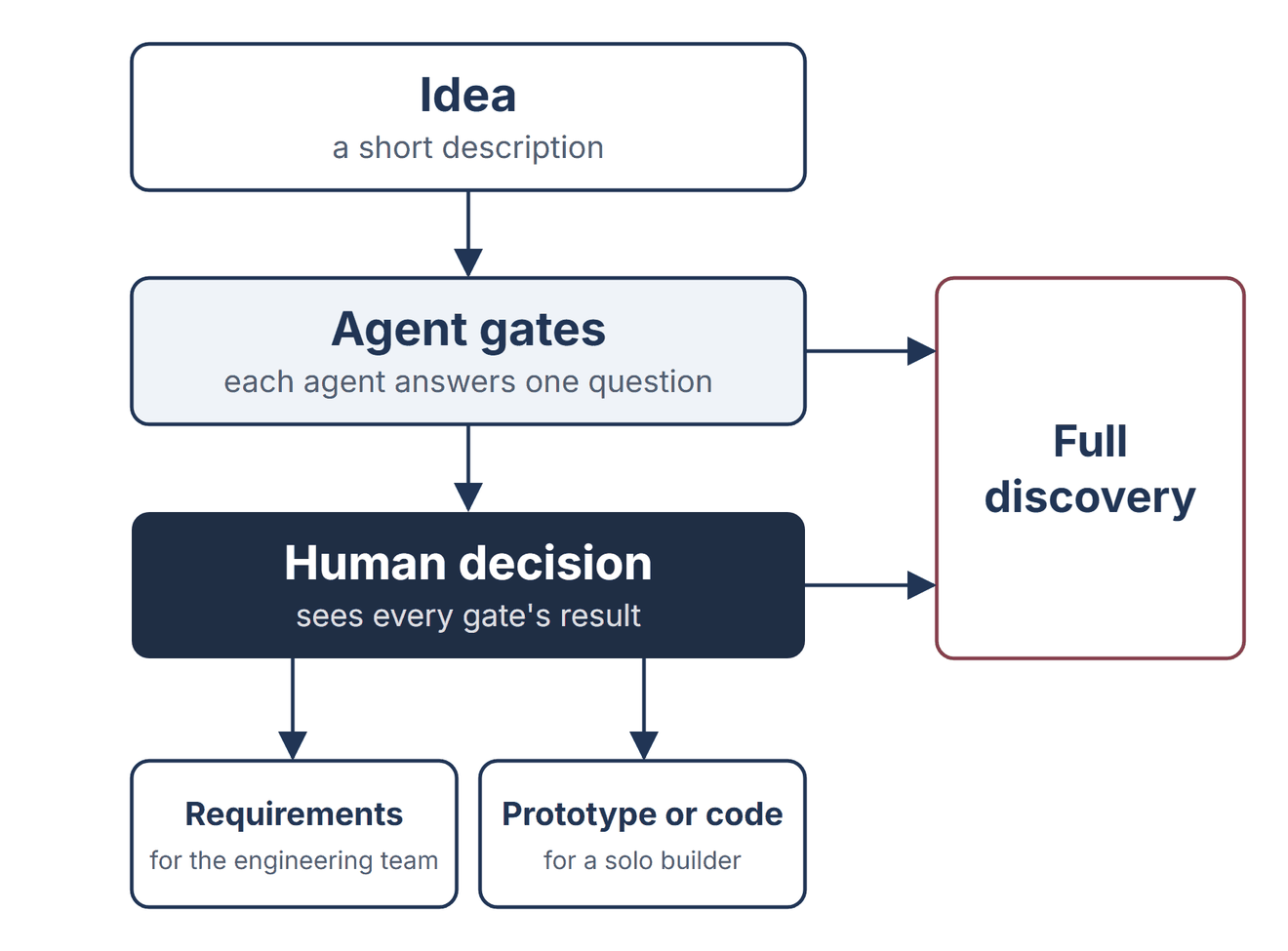
Fast Track Product Discovery is a shortened version of discovery for features that do not need the full process. An idea passes through a series of gates run by AI agents. Each gate answers one question that the team would ask itself in a full discovery.
A well-written specification is not the same thing, because here the specification is an outcome, and an idea may never reach it.
The small research activities of continuous discovery are different too. There, the team goes to customers for new information. The fast track draws on what the team has already collected.
Not every idea qualifies. These are my working criteria.
- the feature is small and can be withdrawn without hurting customers,
- it addresses a problem the team knows from earlier research or requests,
- it can be judged on data we already have,
- it does not touch customers' money, security, or legal matters.
The first condition is harder than it looks, because in B2B products shipped features are rarely withdrawn.
The person proposing the idea should also not be the only one deciding whether it meets the criteria.
The gates
I picture a few connected workflows in which each agent has one job and its own set of skills. An idea enters as a short description and moves through the gates.
What the gates check is up to the team: the market and competitors, existing research and personas, product analytics, a simulated walk through the flow, technical feasibility.
The pattern itself already has names. Anthropic's "Building effective agents" puts gates between the steps of a prompt chain, and those can be plain programmatic checks. Human-in-the-loop approval stops an agent before it acts.
The closest relative I know is GitHub's Spec Kit. Besides the review between spec, plan, and tasks, it now has an idea assessment path. An agent gathers evidence for and against, defines the problem and success metrics, compares options, and ends with go, needs-clarification, or kill.
So the mechanism is not mine. What I am proposing is narrower: using it for small, reversible product changes, on what the team already knows, with written conditions for going back to full discovery.
A gate that works on existing research searches interview notes, support tickets, and customer feedback. It looks for the problem, not for an order for a specific feature. A note about someone retyping numbers into a spreadsheet counts, even if nobody ever asked for an export.
A simulation gate walks through the proposed flow as different personas. An agent playing a persona is not a user, so I treat that gate as a sieve for obvious mistakes and not as evidence.
The gates can mirror the stages of classic discovery, but they do not have to. Each one returns three things: a verdict, the evidence it rests on, and a list of what it could not establish.
Each one is also told to look for reasons against, because an agent is quick to confirm the idea it was handed.
Not every idea needs every gate. The smallest version I can defend runs research and analytics first, together with a quick check of technical scope and reversibility.
That check is mandatory, because a feature that looks small can still require a large change in the code or touch permissions. The deeper feasibility analysis and the other gates are added only when a question stays open.
The person's time is limited by the format: one short summary per gate, read in a single sitting.
The part of this design I care about most is the exit. An idea goes back to the regular path when a gate finds no evidence of the problem, when two gates contradict each other, or when the list of unknowns touches one of the entry criteria.
That is a valid result. A fast track from which nothing ever returns to full discovery would tell me the gates let everything through.
What comes out
At the end a person reads the summaries, judges viability, and picks one of three routes: build it, drop it, or send the idea to full discovery.
In a product team, a decision to build produces requirements ready to hand to engineers, with the reasoning from every gate attached. For a solopreneur, or someone who codes alone with AI, the last step can be a prototype, code, or a feature in production.
A decision to build is not complete without three more lines: the effect we expect, how we will measure it, and the date on which we decide again.
The measure should say more than usage, because a count of clicks alone will not show whether the problem is solved. Without these lines the fast track ends at "requirements ready" and nobody can say later whether the decision was a good one.
Evals for the gates
If a decision rests on the work of agents, I need to know how often they are wrong. That is what evals are for: repeatable measurements of how often a workflow's output contains a known error.
Teresa Torres recently described what that work costs. One customer reported a flaw in AI-generated opportunity solution trees. Fixing it took three weeks, four new evals, and sixteen experiment variants.
Swapping in a newer model was not enough, and prompt changes improved one thing at the expense of another. As she describes it, both kinds of error went down only after she added a deterministic check to the audit loop, and even that took a couple more iterations.
She is helping to build that product, so this is a builder's account and not an independent audit. I still find it the most honest description of the cost that I have read.
This is the biggest cost of my proposal, and I don't want to hide it. Nobody will build evals for one minor feature.
It only makes sense when the same gates serve many ideas, and whether that cost pays back is still an open question for me.
A reasonable start is a set of past ideas whose outcome the team already knows, and a check of what the gates would have said about them. The agent must not be able to see the outcome, or the test measures nothing.
Later the verdicts get compared with what happened after release. Without those two steps, the fast track would just be a way to skip discovery.
When not to shorten
Everything that fails the criteria takes the regular path. A new product, a new customer segment, or a problem nobody on the team can describe in their own words calls for conversations with people.
What worries me most is that the fast track could start to crowd out those conversations. It is a complement to continuous discovery.
The weekly conversations supply the knowledge the gates draw on, so the more a team knows about its users, the more small ideas it could check this way.
For now I have a hypothesis and a few apps of my own to try it on. The hypothesis is that for some small features this path would be more sensible than either of today's extremes, and for those features I would even recommend it.
I'm curious whether this matches what you see. Do you have features that went through full discovery even though everyone knew from the start how it would end? And would you agree with the line I am proposing, that nothing goes on the fast track unless it can be withdrawn?
Thanks for reading!
Sources
- Silicon Valley Product Group, "Experimentation, AI and the Product Model" (Marty Cagan), October 2026.
- Silicon Valley Product Group, "The Four Big Risks" (Marty Cagan), December 2017.
- Product Talk, "4 New Evals and 16 Experiment Variants to Fix 1 Customer Complaint" (Teresa Torres), September 2026.
- Product Talk, "Continuous Discovery | Definition and Overview", last updated September 2026.
- Atlassian, "The State of Product 2027" (Wakefield Research survey fielded 13 to 26 August 2026; methodology note on page 29 of the report), 2026.
- Anthropic, "Building effective agents", December 2024.
- GitHub, "Spec Kit" (repository, version 1.4.4) and "Idea Assessment Quickstart", accessed November 2026.