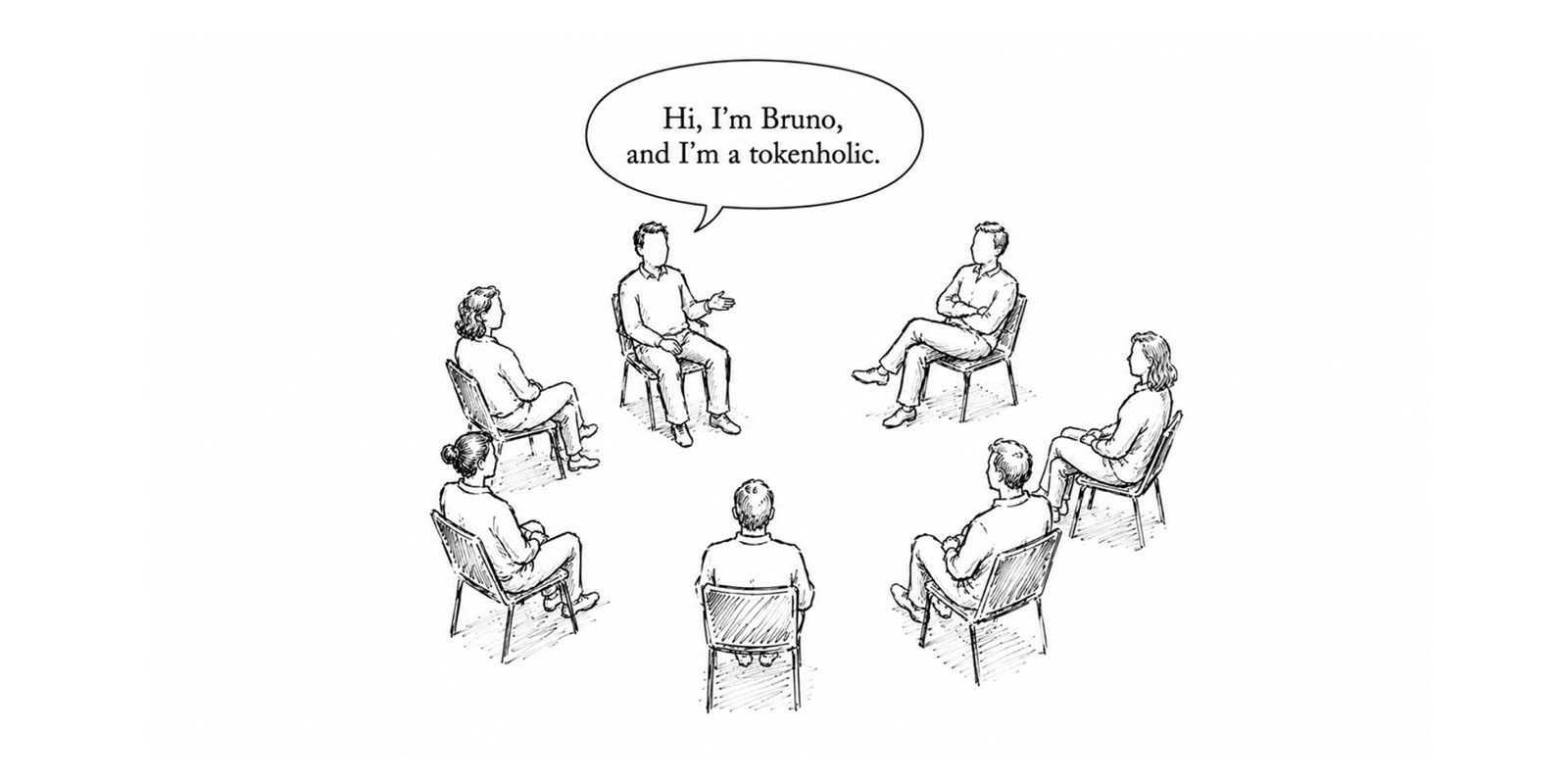
"Hi, I'm Bruno, and I'm a tokenholic."
Bruno is not a real person - he is a hypothetical attendee of a support group that does not exist yet. But the thought of him came to me after reading a few online discussions about how LLMs are changing the way we work. Not just making us more productive - that part gets plenty of coverage - but quietly changing our habits, in ways nobody planned and few people seem to notice while it is happening.
Three small stories
A few examples that stuck with me:
- One person delayed a meeting because their AI subscription was about to reset. The work could have happened earlier; the quota said otherwise.
- Another used multiple AI subscriptions, switching between them to avoid usage limits - a rotation schedule, essentially, for which assistant is "open" at a given hour.
- A third moved to the API because hitting limits became too disruptive. The meter changed from a hard stop to a running bill.
None of these stories are about whether AI is good or bad. Each of them, taken alone, is a perfectly rational response to a constraint. That is what makes them interesting.
They made me wonder if we are slowly adapting our routines to fit the limits of our tools, instead of using tools to support the way we want to work. Taken together, they describe something we have seen before with other metered resources: once a thing becomes central to how you work, its limits start writing your calendar.
The tool was supposed to adapt to us
What strikes me is the direction of the adaptation. The promise of these tools is that they mold themselves to you - your context, your style, your workflow. And within a session, they largely do.
But one level up, the opposite is happening. We schedule around reset windows. We keep a mental ledger of which account has quota left. We save the "expensive" model for questions we have pre-judged as worthy of it, and route the rest to something cheaper. That pre-judging is itself work - a small, constant tax of meta-decisions that did not exist two years ago.
There is a professional irony in here that I feel personally. As product people, we design usage limits for a living - rate limits, tiers, quotas, paywalls. We know exactly why they exist and how they shape behavior. Now we are on the receiving end, and we are being shaped like any other user.
The one-person software team
At the same time, we are seeing more applications built for just one user: their creator.
LLMs let us become an architect, a business analyst, a designer, a developer, and a product manager all at once. They make it possible for almost anyone to build ideas that would have required an entire team just a few years ago. A personal dashboard, a niche automation, a tool that exactly fits one person's workflow - things that would never justify a team now get built in an evening.
I think this is genuinely one of the best things about the current moment. The distance between "I wish I had a tool that…" and having the tool has never been shorter.
But this new way of working also introduces new constraints, and they arrive in a predictable sequence:
- You hit token limits.
- You buy another subscription.
- You add another model for a different perspective.
Eventually, you move to APIs, and your costs keep growing - not because anything went wrong, but because you just want to build one more feature. The building is so fluid that the only remaining friction is the meter, and the meter never resets your ambition, only your quota.
The old constraint was capability: there were things you simply could not build alone. The new constraint is consumption. It is a better problem to have, but it is a stranger one, because it never announces itself as a decision. No single subscription feels expensive. No single upgrade feels like a turning point. The habit assembles itself out of small, reasonable steps.
Who is managing whom?
The challenge may no longer be learning how to use AI. Most of us have crossed that bridge, or are crossing it now.
It may be learning how to make sure AI doesn't quietly start managing us - our schedules bending around reset times, our budgets absorbing one more subscription, our attention spent tracking which tool still has room left today.
I do not have a tidy answer. The honest version is that I recognize parts of this pattern in my own week, which is precisely why the "tokenholic" line landed. A few questions I have started asking myself, and that might be worth borrowing:
- Did I plan this task around the work, or around a quota?
- Would I have paid for this subscription on its own merits, or did I add it to route around a limit?
- When the costs grew last month, was it because the value grew - or just the appetite?
I'm curious if you have noticed similar changes in your own routines. What are your thoughts?
Thanks for reading!
← Back to blog